The LSL ACS v4.1 system has many unique features besides being extremely reliable and robust. This list highlights some of our advantages over the competition.
Advanced Paired Users/Assets/Tags provides for a complete multiple reader hardware pairing relationship between Users, Assets, and Tags. This is of primarily used in Asset tracking applications, but does have significant application is pairing between different groups of Users.
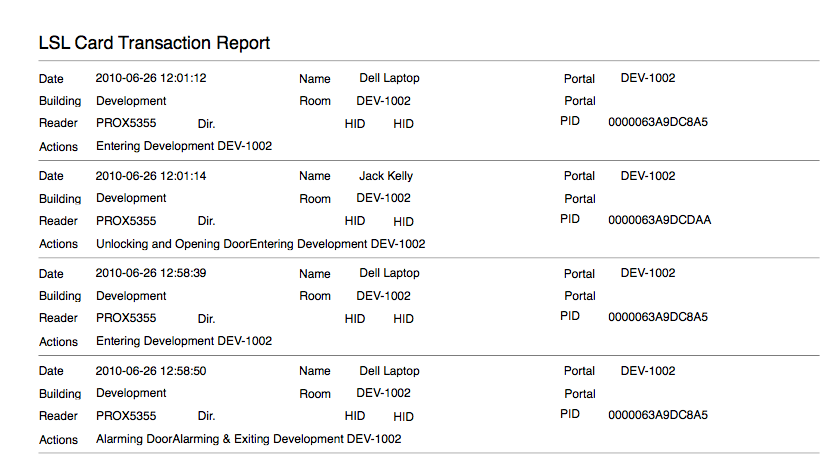
The LSL ACS v4.0 system provides a significant number of reports for analyzing and presenting collected transaction data from SQL database.
More reports are added all the time based on our internal analysis and feedback from our customers.
Report Examples:
All Transactions - By Date: Lists all transactions during a user provided data range.

Click on any of the graphics for a full resolution version.
Example of main LEC window. Shows real time output from all connected portals/devices.
Mac OS X:

Windows 7:

Linux ( RedHat 5 ):
The LSL ACS Communication Server ( LCS ) is a new server component of the LSL ACS system, that can run on Linux, Windows, or Mac OS X. It can run on the same server as the LSL Enterprise Server or on a separate server for performance and redundancy.
For modern multi-core CPU's and in keeping with the LSL design philosophy of completely distributed, no single point of failure systems, this server allows for better balance and superior performance across the LSL RFID Access Control and Asset Tracking product.
The primary function of the LSL Communication Server is the following:
The LSL Enterprise Console ( LEC ) is the graphical user interface for the system. All configuration of the LSL LPN-SEC’s and LSL Enterprise Server are performed through LEC. Users, Portals, Control Options, Authorized User, Portal, and Times, real-time output from the LSL LPN-SEC’s, the LEC is a one stop user interface for the system.
The LSL Enterprise Server ( LES ) provides the core central software server for interacting with the LSL LPN-SEC. All LSL LPN-SEC appliances connect to the LES for configuration, setup, data storage, logging, and user/tag/hardware configuration